| |
Compiled by Maxine Ventham
Reviewed by GERALD ISAAMAN
From the Camden New Journal
Goon but still not forgotten
Nostalgia time. And it’s back to the 1960s and those swinging days when, few will possibly remember, poetry and jazz, an unfamiliar cultural cocktail, was concocted and made its debut in concert form at Hampstead Town Hall.
A queue of people stretched up Haverstock Hill to hear the likes of Dannie Abse, Adrian Mitchell, Jon Silkin and Boris Pasternak’s sister Lydia read his translated poems alongside the Michael Garrick Trio.
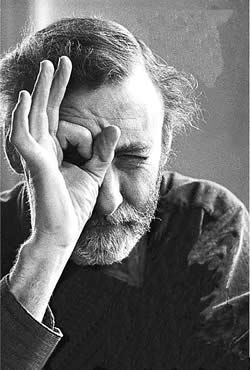
But the truth was that they had come to see one man – Spike Milligan. The irrepressible arch Goon, despite arriving late and spilling his poems all over the stage, was in wonderland:
Sad Hamlet to Ophelia
I’ll draw a sketch of thee
What kind of pencil shall I use?
2B or not2B?
The hall erupted in the kind of laughter that only Spike and his fellow goons could invoke. Poetry and jazz went on to be a sell-out too with Milligan and others at the Royal Festival Hall in June, 1961, which resulted in similar concerts galore round the country.
It all made a name for Jeremy Robson, the dashing young poet-critic later to turn publisher, who organised it all, the anxiety of not knowing what Spike would do next no doubt giving him premature wrinkles.
Now he has recalled it all by commissioning and publishing this anthology, compiled by Maxine Ventham mainly before Spike expired, in which nearly 50 people reminisce about the blessed comic genius in a kind of literary ‘This Is Your Life’.
It is a delight, funny and poignant, with people ranging from Harry Secombe, Roy Hudd and Maureen Lipman to Michael Foot, Barry Humphries and Professor Anthony Clare telling their telling tales of Spike.
Jeremy Robson is, of course, one of them, the more so because his Hampstead psychiatrist father treated Spike, the classic doomed joker, for his depression, and the Robson family became trusted friends. So it is full circle for Jeremy. “For Spike has touched and in many ways altered the course of my life (as he has those of other contributors to this book) and it is good to have the opportunity to say so,” he writes.
As Dannie Abse recalls of that historic town hall evening: “Suddenly I was startled to see this man step forward and say, ‘I thought of beginning by reading a sonnet of Shakespeare’s but then I thought why should I? He never reads any of mine.’ Who the hell was this? I wondered. Magically naïve verses followed that had the audience in stitches.”
As if almost a defence of his own vulnerability, Spike joked about everything. Dannie tells how they stopped for a cuppa in an M1 service station following a TV show in Birmingham, and the waitress brought over countless napkins from customers who wanted Spike’s signature. “It must be awful to be famous,” Dannie mused. “Yes,” responded Spike as the waitress disappeared, “when they know who you are you’ve got to give a huge tip!”
Yet there were deeper sides to Spike, who was also a conservationist and nuclear disarmament campaigner, as Michael Foot observes. “My whole association with him has been nothing but good,” he writes. “I don’t know where his goodness comes from – perhaps it’s being Irish.
“He has a different kind of humanity. Some people think of Socialism like that but I don’t know if I ever used the ruddy word to him.”
Maxine Ventham has performed an admirable endeavour in bringing together the short, sharp, witty, moving and remarkable recollections of so many people who knew and loved him. They provide a lasting picture of a marvellous and unforgettable maverick man – you can open this book at any page and end up laughing.
| |


